
BACKGROUND OF the JAN WIMPFHEIMER CASE
This website serves as a warning to individuals who are thinking about investing with or lending money to Jan Wimpfheimer. It summarizes allegations of serious misconduct that multiple investors contend constitute criminal violations. Complaints have been filed with law enforcement authorities, securities regulators, and bar associations. Wimpfheimer is currently a defendant in multiple civil actions across several jurisdictions and countries.
All references herein describe allegations, not adjudicated facts. However the documentation presented is intended to substantiate those allegations. If proven in court - some involving felony-level offenses - Wimpfheimer could face imprisonment and the loss of his license to practice law.
Jan Wimpfheimer is a UK, US, and Israeli citizen and a licensed attorney residing in Bet Shemesh, Israel. He is alleged to have raised between $20-$30 million dollars from nearly 70 investors who are citizens of the UK, Switzerland, America, and Israel.
In order to convince these people to part with their money, Wimpfheimer offered a fantastic 24% return to some and he offered his personal guarantees on their principal to others. He continues, according to reports, to try to solicit funds for his other 'investments.'
To date, he has allegedly defaulted on tens of millions of dollars in obligations to his investors, refused to share bank records so his investors can't see if their money was invested it or if he embezzled it, and he has not honored his signed personal guarantees.
A common misperception is that is simply a case of an ordinary business failure and investors are simply mad that the business failed. This is not the case.The business, GFE, is doing just fine. The problem is that some of the money given to Wimpfheimer seems never to have made it to the company.
Wimpfheimer claims he defaulted on payments only because his partners stole from him. Before drawing any conclusions, readers are encouraged to review the detailed allegations and supporting documentation below.
Nota Bene
- Wimpfheimer is invited to supply any documentation demonstrating that the allegations below are inaccurate and they will be removed from the website. He can email the documentation to robbyjberman@gmail.com
- Wimpfheimer has been threatening to sue investors for libel for years but he hasn't. Why not? Because if he does he will have to open his bank account for the court to see what he did with the money.
[Image: Wimpfheimer coming out of a Jerusalem courthouse from one of the many lawsuits against him.]

EMBEZZLEMENT
1. Did Jan Wimpfheimer embezzle money?
According to police complaints and court filings, Wimpfheimer embezzled significant amounts of money; Wimpfheimer had investors wire their investment money to an account called Madison Gold LLC. He was then supposed to forward that money to be invested in GFE (aka East Hudson Capital).
But Wimpfheimer admitted to at least one investor, who was his long-time friend of 40 years, that he did not invest all of the funds given to him and he took some of it for himself. That is the definition of embezzlement.
Later on, Wimpfheimer tried to backtrack saying that all he meant was that he took a 3% management fee for himself and not that he had embezzled any money at all.
First, there was no such agreement that Wimpfheimer (aka Madison Gold LLC) would take any fee for management. He had told investors that GFE (aka East Hudson Capital) was taking a 3% management.
Second, even assuming there was a misunderstanding and investors were indeed supposed to be paying a 6% fee for their money to be managed, when investors asked Wimpfheimer to see the bank records of Madison Gold LLC to make sure Wimpfheimer had not taken more than 3%, he refused to show it to them. This seems to imply he has something significant to hide.
If he did embezzle money Wimpfheimer will sit in prison. And if a lawyer embezzles client money even from a business account rather than from an escrow or IOLA account, it is a crime under many New York laws. The lawyer can be charged with: NY Penal Law (§§ 155.40, 155.42); (§ 190.65); (§§ 175.05, 175.10); (18 U.S.C. §§ 1341, 1343). Ethically, the lawyer violates RPC Rule 1.15(a), Rule 8.4(b), Rule 8.4(c), Rule 8.4(h).
[The image shows correspondence where Wimpfheimer is refusing to show the bank outflows to an investor.]

NO TRANSPARENCY
2. People who manage money have a legal responsibility to send investors regular reports showing where the money went and how it is performing.
For example, in this image (not connected to Wimpfheimer) we see a document that Bernie Madoff manufactured reports to present to his investors. He did this because he knew he was obligated to report to his investors where their money went.
Wimpfheimer did not give many (all?) of his investors financial reports, fake or real, other than to say - once in a while - in an email, 'Baruch Hashem [thank God] everything is going fine.'
There are multiple federal laws and SEC regulations that require transparency, truthful reporting, and access to financial records from a money manager. Not doing so is a crime.

FALSE FINANCIAL INFORMATION
3. Wimpfheimer tried to convince an investor to invest money with him by telling him the net worth of the company was $40,000,000. But when the investor investigated the documents and challenged that number, Wimpfheimer responded that the actual number was really $20,000,000. Wimpfheimer blames the CFO for the mistake because "he was working with a moving target."
First, what does the phrase a "moving target" mean?
Second, are we to believe that a Chief Financial Officer, the person responsible for the finance of the company, made a reporting mistake that was off by a whopping 100%? That instead of reporting $20 million he accidentally reported it was $40 million?
Lastly, to the best of our knowledge Wimpfheimer (aka Madison Gold LLC) didn't have a CFO.
If Wimpfheimer knowingly sent false financial information - such as a false valuation of the company - via email in order to solicit an investment it is a crime. Even if the investment was not made it is still a crime that is considered a:
- a federal felony
- and punishable by up to 25 years in prison
[Image: Wimpfheimer making a $20,000,000 misrepresentation in an email.]

COMMINGLING FUNDS
4. Wimpfheimer is a lawyer and as such he knows it is unethical and illegal for a lawyer or a money manager to commingle funds.
Why? Because commingling funds destroys the clear separation that must exist between a client’s money and the manager’s own assets. Clients must be able to trust that their funds are used solely for their benefit, not mixed into operational accounts, personal expenses, or other clients’ money.
Commingled funds make it impossible to track transactions accurately. It creates opportunities for misuse or concealment of losses, and undermines transparency, accountability, and auditability. For these reasons, regulators such as the SEC, FINRA, and state investment-advisor laws strictly prohibit commingling, viewing it as a serious breach of trust that can lead to penalties, loss of law license, civil liability, and even criminal charges.
In this one exhibit [see image], we see Wimpfheimer had an investor wire funds directly to his private account owned jointly with his wife Dr. Orit Wimpfheimer, Chief Medical Officer, for public company Nanox Vision. Even though his wife is now implicated in her husband's financial activities, she has yet to issue a statement distancing herself from it or declaring if she knew what he was doing with their bank account.

NO LICENSE
5. Jan Wimpfheimer was seemingly offering securities and managing money without a license.
In both the United States and Israel, offering securities without a license is a crime. Anyone who solicits investors, gives individualized investment advice, structures deals, or handles investor funds must hold the appropriate license (such as a registered broker or investment adviser registration), and acting without one is itself a federal offense.
Wimpfheimer raised and managed $20 - $30 million in pooled investments. He is not licensed as a broker-dealer or investment adviser. This violates the Investment Advisers Act of 1940 (15 U.S.C. §§ 80b-6, 80b-17), the Securities Exchange Act of 1934 (15 U.S.C. § 78o(a)(1)), and New York’s Martin Act (GBL §§ 352-c, 359-eee).
The Martin Act does not set thresholds by dollar amount or investor count regarding securities. That is to say, even if one investor bought one security solicited by someone without a license it is a felony.
Ask yourself why Wimpfheimer didn't get licensed. It would take one month of study, you get the license and you are done with it. Could it be the reason he didn't get licensed is because that would mean there would be more oversight about what he was doing with other people's money?
Wimpfheimer, without a license, supposedly sold $20m of securities to over 70 people. In fact, the U.S. Supreme Court in Lowe v. SEC, 472 U.S. 181 (1985), upheld sanctions against a New York attorney who, like Wimpfheimer, acted as an unlicensed investment adviser.
Israeli securities law is similar: offering securities to the public without an approved prospectus is a criminal violation and can expose the promoter to enforcement action, fines, and in severe cases imprisonment.
[Image: AI generated.]

FALSE PROMISES OF PERSONAL GUARANTEES
6. In order to convince his friends to invest huge amounts of money with him, Jan Wimpfheimer promised them personal guarantees. A 'personal guarantee' means that even if his business fails - for any reason at all - Wimpfheimer is promising to sell his house and empty his bank accounts in order to return the principal invested (not the interest).
Wimpfheimer personal guarantees state: “In consideration of your making the loan to MG, I hereby agree with you that to the extent you do not receive by the third anniversary of the Promissory Note between MG and you payments of principal and interest equal to at least the Principal Sum from from MG, that I will promptly pay, in immediately available funds and from my own personal assets, the amount necessary to ensure that you have received the Principal Sum in total.”
Wimpfheimer lied. He has not honored his personal guarantees tricking many people out of their life savings. All the while Wimpfheimer lives in a multimillion dollar house with multiple cars walking around wearing a $10,000 Rolex watch. He owns real estate in Kiryat Melachi, Bet Shemesh, etc.
Wimpfheimer reneged on his signed financial obligations which violates RPC 8.4(b), RPC 8.4(c), and RPC 8.4(h). Failure to honor financial commitments is not merely a private contractual breach but constitutes misconduct that strikes at the core of his integrity as an attorney and warrants severe disciplinary sanction.
[Image: One of the many Personal Guarantees that Wimpfheimer gave investors.]

SLEAZY AND DECEPTIVE BEHAVIOR
7. Wimpfheimer tried to convince an old friend of his to give him all of his life savings by offering him a personal guarantee. He said: "You know how wealthy my family is in Riverdale; you know my house is Bet Shemesh is worth millions of dollars."
The friend asked Wimpfheimer if he was giving out more personal guarantees than he is worth because then his personal guarantee is not worth anything. Wimpfheimer said not to worry: "It's less than 50% and I don't intend to give any more."
Later on, when it became clear that Wimpfheimer gave out personal guarantees to many investors - much more than his net worth - his friend asked Wimpfheimer why he did it. Wimpfheimer responded [see Hebrew text]: "I wrote I don't intend to. I didn't write that I wouldn't."
This is sleazy behavior, especially to do this to an old friend.
And even if you want to give Wimpfheimer the benefit of the doubt -that he sincerely meant 'intent' - then once he gave out more personal guarantees than he was worth (in effect making his guarantees worthless) he should have notified his friend that he passed the 100% threshold and now the guarantee is worthless.
It is difficult to reconcile that Jan Wimpfheimer is the son of Michael Wimpfheimer who has a sterling reputation of being an ethical man.

WIMPFHEIMER'S PARTNER DECLARED BANKRUPTCY
8. Jan Wimpfheimer's friend and business partner is Simche Fulda. He also was living in Beit Shemesh. Although Fulda has an unimpressive resume, Wimpfheimer tried to get people to invest with them as a team by vouching for Fulda as being a trustworthy and professional businessman.
Yet it was recently discovered that about 15 years ago, a man by the same name, Simche Fulda from Beit Shemesh, took people's money for investments and then declared bankruptcy. Declaring bankruptcy means you don't have to honor your debt.
Now that Fulda (and his partner Wimpfheimer) has defaulted on millions of dollars to investors, Fulda has taken flight and now lives in Dubai. Yes, an Orthodox Jewish man living in an Arab country. Draw your own conclusions.

WIMPFHEIMER OBFUSCATES HIS BUSINESS
9. Jan Wimpfheimer has many interrelated corporate entities that confused most of his investors - until today they are not sure where their money went. The adjacent diagram was made by one frustrated investor who was trying to figure out where Wimpfheimer moved his money to.
Complicated interrelated corporate structures are widely frowned upon because they create the perfect cover for misconduct: the more layers and entities a manager builds, the easier it becomes to obscure where investors’ money is flowing and to hide improper transfers.
When funds move through a maze of LLCs, partnerships, and affiliated companies, even diligent investors and regulators struggle to trace transactions, allowing unscrupulous actors to disguise self-dealing as “fees,” shuttle money between entities, and ultimately steal or misuse invested capital. This intentional complexity isn’t a sign of sophistication—it’s a red flag that enables commingling, concealment, and fraud.
For example, when Wimpfheimer was asked to explain why there was a $4 million transfer of funds to a related corporate entity he said something about "operating expenses" but refused to reveal who who owned that entity or what those operating expenses were for.
NYSBA Op. 1256 (2023), NYSBA Op. 1231 (2021) and NYC Bar Formal Op. 2024-2 confirm that while complex corporate structures are not inherently unlawful, they are unethical or fraudulent when used to mislead investors, obscure control, or hide financial risks—misconduct for which New York has repeatedly imposed disbarment. It also violates RPC Rule 8.4(c) and Rule 1.8(a). A lawyer raising funds through confusing interlocking entities can violate these rules even absent investor losses.

WIMPFHEIMER OWES A LOT OF MONEY TO MANY PEOPLE FOR MANY DIFFERENT REASONS
10. More and more people are suing Jan Wimpfheimer for different investments. The one presented here shows that the court ruled that Wimpfheimer has to pay this person $600,000 and he has yet to do it. If you speak to Yossi Schulman, and ask him what Jan did that got this judgement against him you will ask yourself how is that Jan keeps his law license. Google Jan Wimpfheimer and you will see more lawsuits against him.

DID ORIT WIMPHEIMER KNOW?
11. Did Orit Wimpfheimer know or participate in her husband's financial fraud? We won't know all the details until the police complete their investigation but here are three things we do know:
1. COMMINGLING
Orit's joint bank account was used by Jan to commingle investor funds with personal funds. Commingling is illegal and doing so carries a jail term.
Orit could try to claim that she is financially unsophisticated and did not know what was going on with her bank account. But Orit was the founder of a company called Remote Radiology International, she was Chief Medical Officer for Zebra Medical Vision, and she is now Chief Medical Officer at Nano-X Imaging Ltd, which is a publicly traded company on NASDAQ (ticker: NNOX).
Playing stupid about understanding a simple bank statement and not noticing strangers depositing money into her bank account will be a hard story to sell the judge.
2. MOVING ASSETS
Jan gave many friends signed personal guarantees to entice them to give him all of their money by promising them that his assets, which includes his multi-million dollar house in Bet Shemesh, would guarantee their principal if the investment failed for any reason.
But when Jan started defaulting on his friends in 2024, he and Orit quickly took out a $2 million mortgage on their Bet Shemesh house they jointly own. The very same house Jan promised his friends would back up his guarantees.
When asked in court why he took out the mortgage, Jan slowly mumbled: "I don't... exactly.... completely ... remember why." He was asked what he did with the money. His lawyer strenuously objected to the question. The judge forced Jan to answer. He then reluctantly admitted in court that he was moving his money to Dubai. Moving and hiding assets to escape paying debts is illegal.
Is it conceivable that Orit signed mortgage documents with the bank to remove $2 million of equity on her home without asking Jan what he was planning on doing with the money? That will also be a hard story to sell the judge.
3. HIDING ASSETS?
It seems Jan tries to hide his assets from many dozens of his creditors, such as Yossi Schulman, Noam Erez, et al. For example, he paid all cash for a penthouse in Kiryat Malachi which keeps it off the grid, i.e. hidden from the eyes of creditors.
His son Ariel Wimpfheimer bought a multi-million dollar villa in Bet Shemesh when he was 18 years old.
- All utility bills (electric, water, etc) are in Jan's name.
- The villa is rented and the lease is cosigned by Jan.
- all negotiations for the villa are done through Jan.
Fraudulent transfer of assets (like from parents to a son) in order to hide them from creditors is a crime. Was this an example of hiding assets or fraudulent transfer of assets? We don't know and only the police and courts will make that determination.
BOTTOM LINE
How much did Orit know about Jan's fraudulent activities?
Could Orit's behavior make her an accomplice to these crimes?
Time and the police and the courts will tell.
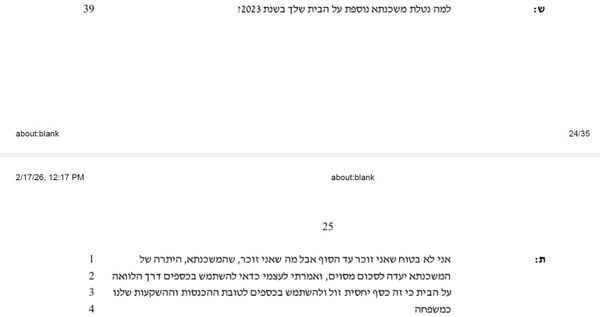
JAN IS MOVING HIS MONEY OUT OF REACH
12. On February 8, 2025, in the Jerusalem Magistrate court two days ago, Jan Wimpfheimer was cross-examined. He admitted that he and his wife took close to $2 million of equity of their house and had no concrete explanation why. [see image of court transcript.]
Could it be because Wimpfheimer gave a lot of investors personal guarantees saying his house would back it up and now he knows they are coming after his house?
The lawyer asked Jan directly - who was under oath: "have you been moving money from your Israeli bank accounts to outside of Israel, to exotic countries like Dubai, Morocco, etc?"
Jan’s lawyer jumped up and shouted: I object to this question your honor! This is not a legitimate question! Jan has shown no signs of moving money out of the country! This is a fishing expedition!
JUDGE: “I will allow it.”
Jan then admitted that for the past few years he has been moving millions abroad. We investors suspected this all along and Jan and finally admitted to it in open court. It was a sad day for Jan, a sad day for Jan’s children and a sad day for Jan’s friends who still believed in him.

JUDGE CAUGHT JAN LYING
13.
The Israeli courts granted one investor a lien on Wimpfheimer's house in Israel to make sure he gets his money back. In October 2025, Wimpfheimer went to court claiming that there is no need for the lien on his house claiming he has the financial capacity to pay back the money. He claimed he has no financial difficulties… “just the opposite.”
First, if this is true, it of course begs the question that if Wimpfheimer has plenty of assets why is he not keeping his word and paying people the money that he personally guaranteed he would pay them.
Second, just two months earlier, in August 2025, in an effort to persuade the NY Grievance Committee not to disbar him, Wimpfheimer claimed he needs his law license because his financial situation is dire.
He wrote to the NY Grievance Committee that he has “suffered devastating personal and financial losses” and he has “lost over 10 million dollars.” He also wrote he did not anticipate that his…." net worth…would be wiped out." The Israeli judge read his testimony to the NY Grievance Committee and accused Wimpfheimer of "contradicting himself" which is the nice way of a judge to call someone a liar.
The only thing Wimpfheimer could say in his defense was that his testimony to the ethics committee in the United States was "...a confidential proceeding and was not supposed to be submitted” to the Israeli court. The courtroom laughed at this ridiculous argument and the judge denied Wimpfheimer's request to remove the lien.
[Image generated by AI]

SELLS UNREGISTERED SECURITIES
14. It seems that the instruments sold by Jan Wimpfheimer—LLC membership units, promissory notes, and pooled fund interests—are considered securities under SEC v. W.J. Howey Co., 328 U.S. 293 (1946). If so their sale required registration with the SEC under § 5 of the Securities Act of 1933 (15 U.S.C. § 77e) or a valid exemption.
The sale of securities without registration is a crime. Under the Securities Act of 1933, all offers and sales of securities must be registered with the SEC unless exempt (15 U.S.C. §§ 77e, 77l).
Anyone who fails to register securities and omits the legal status of the offering, is actually deceiving investors and engaging in conduct reflecting adversely on his or her fitness to practice law. Under New York’s Martin Act (GBL Art. 23-A) it is a felony.
Such behavior is proscribed by RPC 8.4(b) and (c), and for a lawyer it demonstrates a serious breach of professional integrity.
FAILS TO RESTRICT INVESTORS TO THOSE WITH ACCREDITED STATUS
15. Under Regulation D, Rule 501 (17 C.F.R. § 230.501), only accredited investors may participate in certain private offerings. Many of Wimpfheimer's investors did not qualify as an accredited investor. Nor would many of them be legally considered ‘sophisticated’ investors. Wimpfheimer failed to verify investor eligibility, voiding any exemption and rendering the offering unlawful.
Reg D allows up to 35 non-accredited investors in certain offerings (Rule 506(b)) if they receive detailed disclosures. Wimpfheimer had about 70 investors (twice the allowed number) many of whom are not accredited investors and many of whom did not receive detailed disclosures.
If true Wimpfheimer violated the Securities Act of 1933 (§§ 5, 12, and 17(a)), the Exchange Act Rule 10b-5, and state blue sky laws, and 18 U.S.C. §§ 1341, 1343. He violated RPC Rule 1.8(a), Rule 8.4(b), Rule 8.4(c), and Rule 1.15.
FAILS TO DIVULGE INFORMATION THAT HE IS REQUIRED TO DISCLOSE
16. Under Rule 502(b)(2)(B) of Regulation D raising an amount greater than $7.5 million requires full audited financials complying with SEC Regulation S-X (same as public company standard). Seemingly Wimpfheimer raised more than this amount and if so he committed a felony crime in that his investors did not get full audited financial statements.
By soliciting investment funds without providing the audited financial statements required under Regulation D for offerings to non-accredited investors, he would have violated Sections 5, 12, and 17(a)of the Securities Act of 1933 (15 U.S.C. §§ 77e, 77l, 77q), Rule 10b-5of the Securities Exchange Act of 1934 (17 C.F.R. § 240.10b-5), and the New York Martin Act (GBL Art. 23-A), each of which prohibit the sale of unregistered or fraudulent securities and treat material omissions as securities fraud punishable as a felony. Also it violates RPC Rule 1.8(a), Rule 8.4(b), and Rule 8.4(c).

WIMPFHEIMER FAILS TO COMMUNICATE
17. As a money manager, Wimpfheimer is required by law to regularly update his investor about the status of their investments. He didn't and doesn't.
When Wimpfheimer's partners suspected him of fraud, they asked the investors to share with them their notes and guarantees that Jan drafted and signed. Frantic not to be discovered, Wimpfheimer demanded his investors not show their notes to his partners.
And to punish those that did, he stopped updating them about their money. He removed those investors from the investor email distribution list and refused to answer their calls and emails.
The refusal by a money manager to update investors on the status of their investments constitutes a fundamental violation of U.S. federal securities law, primarily the Investment Advisers Act of 1940 (Advisers Act). The most severe infraction is the breach of Fiduciary Duty.
As fiduciaries, money managers must, at all times, serve the best interests of their clients, which includes the duty of care and the duty of loyalty. The SEC views the deliberate withholding of material information—such as the status, performance, or location of client assets—as an act that places the adviser's interest ahead of the client's.
This directly violates the fiduciary standard and can trigger the Anti-Fraud Provisions of Section 206 of the Advisers Act, which prohibits any "act, practice, or course of business which is fraudulent, deceptive, or manipulative."
Furthermore, this failure to be transparent also breaches specific regulatory mandates. SEC rules require investment advisers to maintain and provide access to accurate financial records and communications. Specifically, Rule 204-2 mandates the keeping of books and records relating to the advisory business, and the refusal to provide these documents, such as bank statements or client ledgers, violates these recordkeeping and client access requirements.
Wimpfheimer’s refusal to provide investors with ongoing updates about Madison Gold Ltd. violated his fiduciary and professional obligations of communication and disclosure. As a money manager, under the Investment Advisers Act of 1940 and SEC v. Capital Gains Research Bureau, Inc., 375 U.S. 180 (1963), he is obligated to furnish full and fair disclosure of material facts, including the use of investor funds, risks, and performance. The Martin Act (GBL § 352-c) independently requires disclosure of material information to investors in New York, treating nondisclosure as securities fraud even absent proof of intent. As an attorney, Wimpfheimer also violated RPC 1.4,, RPC 8.4(c) and (h).
Collectively, the intentional failure to report to investors is treated by the SEC as a fraudulent scheme designed to conceal incompetence or, worse, misappropriation, exposing the adviser to enforcement actions, civil liability, and potentially criminal prosecution.

WIMPFHEIMER THREATENS HIS INVESTORS
18. Wimpfheimer’s partners offered investors the opportunity to buy their notes at a 50% discount. In order to begin negotiations, they needed to see investor's notes. Why? Because Wimpfheimer had kept his partners in the dark by using a coded investor list so even they did not know who the investors were or the amount each one invested or the interest rates they were promised. (We investors have heard that Wimpfheimer sold illegal usurious notes and $5,000,000 of his notes were nullified by an arbitration panel).
When Wimpfheimer caught wind of this offer by his ex-partners – a legal offer to buy investors’ notes - he warned his investors that if they just show their notes to his partners they will be breaking their NDA with Wimpfheimer and he will take legal action against them. (Wimpfheimer often tries to scare investors into silence by claiming they are breaking their NDAs every which way but Sunday.)
So here you have a case of investors who realize that Wimpfheimer is not going to give them back their money and they are trying to legally sell their notes they received from Wimpfheimer for 50 cents on the dollars and Wimpfheimer is trying to stop them.
On January 20, 2025 he wrote:
“Our cooperation, sharing of information, etc., however, does depend on a confluence of interests.”; “Our continuing efforts will be for the benefit of those who are patient with us as we fix this debacle.” And then he wrote in bold font in case it wasn’t clear that he was making a threat “If anyone attempts to sell a promissory note or other rights to our adversary [he is referring to his partners as adversaries], we have no further obligations [to] that person. If your actions cause damage or loss for other investors, then this might lead to additional consequences. All rights reserved.”
Signing an NDA does not give the money manager legal cover to threaten an investor into silence about possible misconduct nor to prevent them from doing a legal act - such as selling their notes. This conduct by Wimpfheimer possibly violates NY Penal Law § 135.60), NY Penal Law § 155.05(2)(e)), NY Penal Law § 195.05; and 18 U.S.C. § 1503), as well as violates RPC Rule 8.4(b), (c), and (d).

WIMPFHEIMER FRAUDULENTLY MISREPRESENTS INTERNAL CONTROLS
19. Wimpfheimer convinced people to invest with him because they trusted him. But they were concerned about his partners whom they did not know.
Wimpfheimer promised them verbally and in writing [see image] that he had internal control over the companies involved and there was no way his partners could steal the money. Now he is claiming his partners stole the money.
If his assertion is true, then he didn't have the control he claimed to have had. He fraudulently represented material facts in order to lure his investors into a feeling that our money was secure and we did not have to worry about fraud or theft.
In this image you can see in an email to one investor where Wimpfheimer wrote "... East Hudson Capital LLC, the operating business, of which I control half of the interests and managers. We [he and Simche Fulda] also have extensive control over East Hudson via restrictive covenants.”
In the other two images you can see two different corporate documents he sent to potential investor where Wimpfheimer represents himself as a principal in the company who has control over the company.
How is it then that Wimpfheimer claims his partner Boris Musheyev removed Wimpfheimer's access to the accounts and "stole" all the money? What happened to Wimpheimer's claim of control?
If found guilty of misrepresenting material facts (his ability to provide checks and balances over the funds) Wimpfheimer possibly violated federal securities laws, including Section 17(a) of the Securities Act of 1933 (15 U.S.C. § 77q) and Section 10(b) of the Securities Exchange Act of 1934 and Rule 10b-5, (15 U.S.C. § 78j(b); 17 C.F.R. § 240.10b-5), 18 U.S.C. §§ 1341, 1343, and the Martin Act (GBL Art. 23-A). It also would violate RPC Rule 8.4(b), Rule 8.4(c), and Rule 1.8(a).

JAN HAS CHUTZPAH
20. Wimpfheimer is barred from leaving Israel. Among his many creditors, Yossi Schulman argued that Jan posed a flight risk, and the court agreed, issuing an exit ban preventing Wimpfheimer from leaving the country.
This winter, Wimpfheimer approached Schulman and asked whether he would consent to lifting the ban so that Wimpfheimer could take his family skiing in the Alps.
Wimpfheimer has taken approximately $30 million, financially destroyed multiple victims, told the NY State bar he has been financially wiped out and he has refused to honor his personal guarantees to return investors’ principal. Despite this, he had the audacity to request permission for a luxury ski vacation. He has nine children—meaning airfare and lodging for eleven people.
[Image is generated by AI]

IS jan's REAL ESTATE DEAL A PONZI SCHEME?
It seems that Wimpfheimer organized a real estate investment in Tiberius back in 2017. A few investors of that deal said that Wimpfheimer told them the investment did not work out and, if they choose, he can "roll" their investment into another real estate deal of his in Beit Shemesh.
Alternatively he would be willing to give them double their investment back if they wait a few years and he, Wimpfheimer, will personally guarantee it. (Wimpfheimer is known for offering investors personal guarantees.)
Let's parse this out.
What does it mean to "roll" your investment into another deal? If the deal lost your money it is gone. There is no money to invest somewhere else. I think what is being done here is that Wimpfheimer doesn't want investors to sue him and ask tough questions and demand to see certain documents so he offers them hope.
I think Wimpfheimer is hoping that his other real estate deal in Beit Shemesh will make money and he will be able to pay back investors from his failed deal in Tiberius. This is a useful way to keep investors calm so they don't ask too many questions.
So what happened to Wimpfheimer's new real estate deal? Apparently Wimpfheimer's real estate deal in Beit Shemesh is stalled or dead.
And at least one investor who took the 2x option on his investment said the date came and went and Wimpfheimer did not make good on his personal guarantee. All the the while Wimpfheimer admitted in court that he is liquidating his assets and moving his money abroad to Dubai... far far away.
If Wimpfhiemer told one investor that the Tiberius deal made money and told another investor in the same deal that it lost money, that would seem to be a ponzi scheme. We will wait for the police to investigate this and determine what happened.
WIMPFHEIMER'S SLAUGHTERHOUSE
22. Wimpfheimer is now trying to get people to invest in his latest project: to build an abattoir in Lithuania. He told one potential investor that he was trying to solicit that the project will be worth 100 million Euro in just one year. Wimpfheimer also promised him.... you guessed it... fantastically high returns and a personal guarantee.
[Image: AI generated]